NAS Data Recovery

Recover data from NAS devices

NAS Data Recovery

Recover data from XFS- or EXT-formatted NAS devices, such as Buffalo, Seagate, Western Digital, DLink, or Iomega systems. Supports single-drive, RAID-0, RAID-1, and RAID-5 configurations. Automatically finds NAS RAID parameters, such as start sector, block size, rotation, and drive order. Easy-to-use wizard with no user input required for fully automated recovery.

Price: $99

Version: V4.02, September 24, 2022

Updates: Free lifetime updates for licensed users

System Requirements: 4 GB RAM, Windows 95, 98, ME, 2000, XP, Vista, 7, 8, 10, 11, Server 2008-2022, 32 or 64 bit

A disk controller card capable of handling all RAID drives individually is required.

Highlights

  • Recover XFS- or EXT-formatted NAS devices, such as Buffalo, Seagate, Western Digital, DLink, or Iomega, within minutes 

  • Supports single-drive, RAID-0, RAID-1, and RAID-5 configurations

  • Automatically finds RAID parameters

  • No other software needed

  • Comfortable viewer for many file types

  • Easy-to-use wizard with no user input required for fully automated recovery. 

  • Safe, read-only design

  • Run from a WinPE Boot Medium or a Runtime Live CD

  • Free lifetime updates with purchase

  • Robust disk search feature

Network Attached Storage (NAS) Recovery Software

NAS Data Recovery recovers the entire content of your failed NAS. You will be able to copy the files and folders over to another disk.
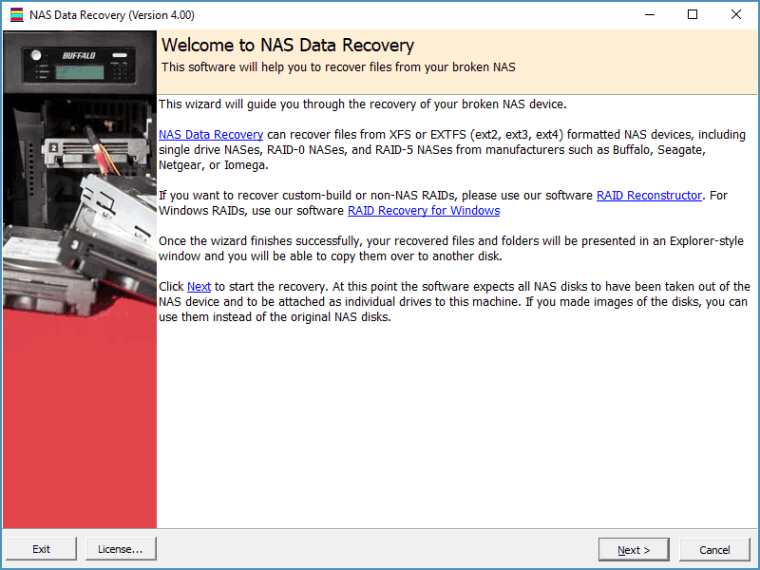
NAS Data Recovery

NAS Data Recovery: Wizard's first step

NAS Data Recovery works for all XFS- or EXT-formatted single-drive, RAID-0, RAID-1, or RAID-5 NAS stations from manufacturers such as Buffalo, Seagate, Western Digital, DLink, or Iomega.

Remove the drives from your NAS station and attach them locally to your machine. Make sure the drives are all recognized by Windows Disk Management. If you are trying to recover a RAID-5, it is OK to attach one fewer drive than the total number of drives in that NAS. NAS Data Recovery also works with images of your drives.

Install NAS Data Recovery to your computer and start the program. A wizard will guide you through the recovery. A couple of minutes later, an Explorer-like window will show all recoverable files and folders. Now you can copy your data over to another disk. You can also view many file types before copying them, e.g., pictures, documents, etc.

NAS Data Recovery is easy to use. It automatically finds all parameters needed for the recovery, such as RAID start sector, block size, rotation, and drive order. No data recovery background is required. No need to buy any other software.
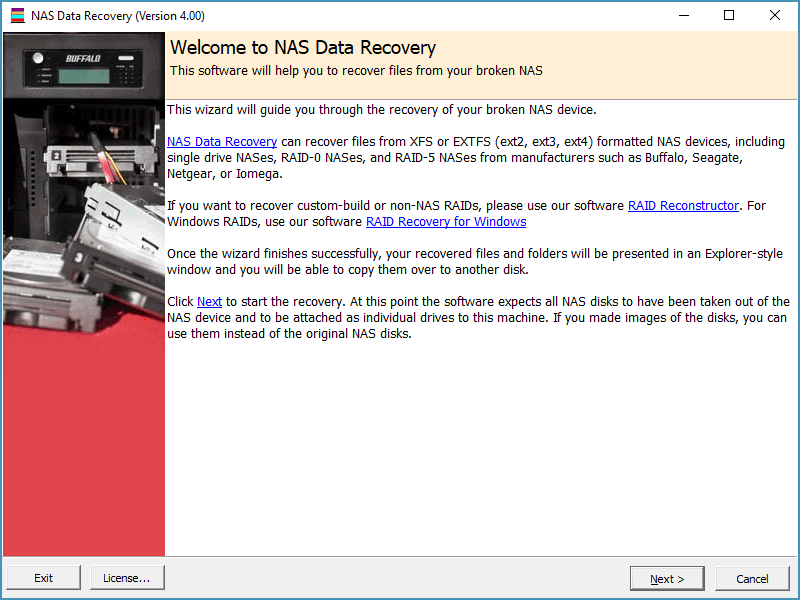
Supported NAS Devices

NAS Data Recovery supports the following NAS devices:

  • Buffalo, DLink, Seagate, Western Digital, or Iomega NAS devices configured as single-drive, RAID-0, RAID-1, or RAID-5 

  • XFS- or EXT-formatted NAS devices from other manufacturers, configured as single-drive, RAID-0, RAID-1, or RAID-5  

Free Lifetime Updates

NAS Data Recovery comes with free updates for the lifetime of the software. Once you buy a license, you will always have access to the latest versions of our software.

No Working Windows?

Run NAS Data Recovery from a WinPE Boot Medium  or our Runtime Live CD.

Additional RAID Resources

  • If NAS Data Recovery is unable to recover your NAS, you might need to use the more complex RAID Reconstructor. Read a case study on how to recover a RAID-5 Iomega StorCenter IX4-200D with RAID Reconstructor.


  • If you want to recover a Windows RAID, check out our RAID Recovery for Windows software.

  • Do you have an exotic RAID? Check out our RaidProbe service.

  • Watch our YouTube tutorial. It shows a data recovery from a broken Buffalo Linkstation Duo NAS. 

© 2026 Runtime Software